
 2 months ago
64
2 months ago
64

DBenitostock/Moment RF/Getty Images
Forty percent of Americans have their daily lives interrupted by uncomfortable bowel symptoms, according to the American Gastroenterological Association. That's a lot of troubled guts.
But Dr. Trisha Pasricha says at the other end of the spectrum, there are people who experience "poophoria." That's Pasricha's term for a state of being where doing your business is painless and worry-free. " I just want you to poop quickly, effortlessly, and then go live your best life," she says.
Want the latest stories on the science of healthy living? Subscribe to NPR's Health newsletter.
Pasricha is the director of the Institute for Gut-Brain Research at Beth Israel Deaconess Medical Center, an assistant professor of medicine at Harvard Medical School, and writes for the Washington Post. She also treats patients with IBS and other painful digestive issues that can be tricky to diagnose.
Pasricha's is not a one-size-fits all approach. There's no magic number of times you need to go in a day, nor a perfect color or consistency that means you're healthy or normal, she says. But if you often struggle with issues like bloating, constipation or diarrhea she wants you to know: There's a better way to poop.

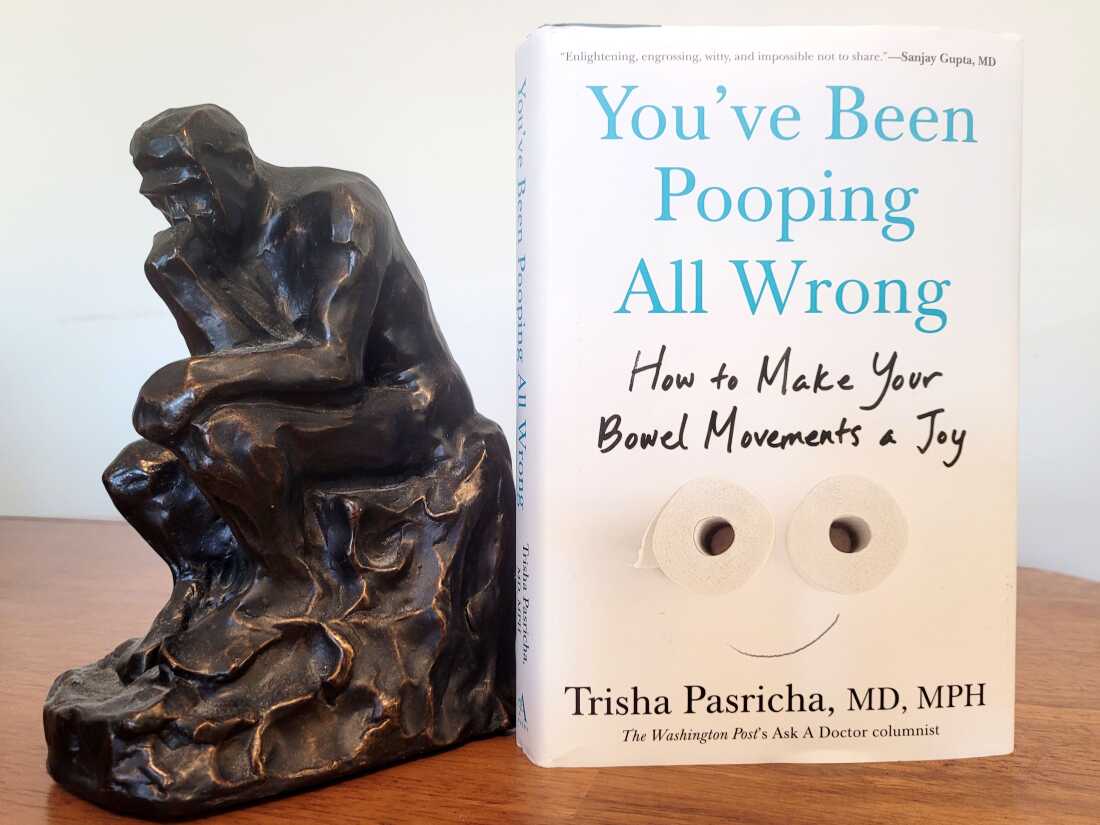
In her new book You've Been Pooping All Wrong: How to Make Your Bowel Movements a Joy Pasricha lays out evidence-based habits and practices to make your relationship with your solid waste as smooth as possible. Here are some of her most tried-and-true tips. Pasricha offers much of this advice to her patients — but following it just might save you a trip to the doctor.
Do: Take a look at your Number 2
A lot of people are shy about looking at the toilet bowl but Pasricha says you can learn a lot if you do. Very hard, small lumps or watery, soupy liquid are both cause for concern. A spectrum of shades is fine — but seek medical attention if you see black or whitish stool. A red or maroon color may indicate bleeding, or it can just give you insight on how long it took you to digest those beets.
When it comes to how often you go, there is a normal range: Pasricha says having a bowel movement anywhere from three times a day to three times a week can be perfectly healthy.

Do: Eat more fiber, and experiment with spices
Why is fiber at the top of the list when it comes to digestive health? It's a real problem-solver even in the short term, Pasricha says. "If you have diarrhea, it forms this gel that kind of pulls it together and makes it more formed. If you have constipation, it softens it up," she says.
Even more importantly, fiber is food for the microbes in your colon. Those microbes in turn produce short-chain fatty acids that reduce inflammation in the gut. Some of these fatty acids like have been linked to lower risk of colon cancer, and reduced risk of heart attack and dementia.
Since most people don't get enough fiber in their diets, Pasricha often recommends a psyllium supplement — a plant-based powder that you can mix into water or coffee. Or you can learn which foods are high in fiber and amp up your intake.
Loading up on spicy food cooked with hot peppers can sometimes kick your bowel movements into overdrive, and not in a good way. "But if you eat just the right amount, it can actually, in the long term, prevent pain and help you stay regular," Pasricha says. Other seasonings including mustard, oregano, garlic and horseradish have been shown to stimulate the same nerve receptors.

Don't: Consume a lot of ultra-processed foods and artificial sweeteners
Research has found concerning links with ultra-processed foods and digestive troubles. Specifically some additives and emulsifiers appear to "decrease the mucus barrier that's on our guts, and can change the microbes," Pasricha says. A study she cites in her book of over 200,000 human participants found that people who ate higher amounts of ultra-processed foods were 20% more likely to have irritable bowel syndrome compared to those who ate the least.
Pasricha also advises her patients to steer clear of foods with artificial sweeteners — often advertised as sugar-free — because they're known to cause diarrhea and bloating.
Don't: Spend more than 5 minutes on the toilet
Researchers think that sitting for extended periods on a toilet seat with an unsupported pelvic floor can increase risk for hemorrhoids. Hemorrhoids are actually something we all have, Pasricha says. They're cushions of veins that sit inside the rectum. Sitting suspended over the toilet bowl for too long may weaken the connective tissue around the hemorrhoids, "and those veins start to bulge, then they pop out and they become inflamed and angry," she explains.
What to do instead: Get up and move your body
If you're perched in the bathroom for more than five minutes without results, take a movement break. Any amount of exercise can be beneficial, Pasricha says. "Studies have found that even just a brisk walk will be enough to help stimulate contractions of your bowel movement."
Don't: Bring your phone to the throne
After seeing a study from Great Britain from 1989 about people reading the newspaper in the loo, Pasricha decided to try an updated version in her own lab. She focused, of course, on smartphone use. Her team at Beth Israel surveyed 125 people about their lifestyle and bowel habits. Then the patients went in for colonoscopies and the doctors noted whether each patient had hemorrhoids or not.
The result? People who said they used their smartphones on the toilet were 46% more likely to have hemorrhoids than those who went device-free. "We found out that you were five times as likely to spend more than five minutes in the bathroom if you brought your smartphone in," Pasricha says.
Aside from distracting you from the job at hand, Pasricha points out that there's plenty of research on the stress-inducing effects of social media. " You're doom scrolling. You're like getting caught by some rage bait," she says. And stress can make it harder for the muscles in your pelvic floor to relax enough to clear the pipes..
What to do instead: Try some light print material
When she was a kid, people used to keep "bathroom reading" within easy reach of the seat, Pasricha notes with nostalgia. "To me, the ideal bathroom reader is something that gives you quick takes like a comic book, like short magazine articles, and ideally it should be from like three months ago," she says.
If you absolutely must look at your phone, Pasricha tells patients to set a "two TikTok limit." "That's, I have to bring my phone in, but after two TikToks, I'm gonna check in with myself and make a decision."
Do: Squat, and lean forward
When you're sitting at a 90-degree angle, a muscle called the puborectalis curves around the colon like a sling and helps keep it shut. But when you're defecating, you want the tube of your bowel to be able to straighten out. And that's where squatting comes in.
Pasricha says there's no need to abandon the comfort of a modern toilet — instead put a stool or a pair of yoga blocks under your feet to raise your knees higher than your hips. "That basically allows that muscle to relax so that the tube straightens up again," Pasricha says.
And to perfect your pooping posture, look to the famous sculpture, The Thinker by August Rodin. The figure is leaning forward, resting his elbows on his knees. There's research suggesting "that's the optimal way," to help straighten the angle of the tube, says Pasricha.
Gut health is complex, and can change with age, shifts in lifestyle, and a whole number of other factors. If something seems off, don't be shy about bringing it up with your doctor, Pasricha says. " I get a lot of pictures of poop in my clinical messaging tool and I mean, it's very helpful."