 2 months ago
53
2 months ago
53

Vendors sell kites in a market area near Mochi Gate ahead of the springtime festival Basant in Lahore, Pakistan. This is the first time in 19 years that the kite festival has been held legally in the city. Betsy Joles for NPR hide caption
toggle caption
Betsy Joles for NPR
LAHORE, Pakistan — Ahead of this month's springtime festival of Basant, people crammed shoulder to shoulder into the narrow, dimly lit streets near Mochi Gate in Lahore's Old City, looking for kites and the string needed to fly them. Men crowded shop windows to see what supplies were being offered and for how much — calling out in exasperation over inflated prices. Each legally sold kite was stamped with a QR code, signaling that the vendor was registered with the government and allowed to sell.
This is not the scene that shoppers here remember from Basant in the past. The kite festival was legally held this month in Lahore for the first time since 2007, when a provincial ban on Basant took effect, with earlier kite flying regulations put in place in 2005. Basant's return for three days in early February saw a more regulated version of the traditional spring festival — with strict rules for kite sellers, banned items for buyers and a set window for when kites were allowed in the sky.

Men shop for kites in a market area near Mochi Gate. Betsy Joles for NPR hide caption
toggle caption
Betsy Joles for NPR
"In my childhood, if you wanted to fly the kite, any day, any event, you can fly," says Hashir Rayan, 30, emerging from the throng near Mochi Gate carrying a stack of colorful kites. "Right now, it's very restrictive."
There was a reason for these restrictions: Kite flying in Punjab had become lethal. In the years leading up to the provincial ban, dozens were killed during Basant — some cut by kite strings coated with chemicals and glass paste.
Late last year, the provincial government passed new legislation on kite flying and sales ahead of Basant's revival. This law, which includes stricter punishments for those who don't comply, repealed a 2001 ordinance on kite flying. Now, kite flyers who break the law face a possible prison sentence of up to five years or a fine of more than $7,000, or both.
Kite-flying as competitive sport
Basant was celebrated with color-drenched rooftop parties and kite flying that carried on late into the night — a source of nostalgia for many, and concern for others, who fear the festival can't be celebrated without incident.

People gather on rooftops in Lahore's Old City to fly kites during Basant. Betsy Joles for NPR hide caption
toggle caption
Betsy Joles for NPR
That's because for many in Lahore, kite flying isn't a leisurely pastime. It's a competitive sport. Kites encircle each other in the air, and their handlers try to cut each other's strings, cheering "bo kata!" (cut!) when they succeed and sending patterned diamonds toppling from the sky.
Over time, this competition gave rise to the use of stronger, synthetic kite string, as well as chemical- and glass-coated varieties for advantage in kite battles.
Saleem-ud-Din, a veteran kite maker in Lahore, says the increased use of this string changed things. "It became dangerous," he says, adding that he and other craftsmen didn't approve. "We say whatever bad thing people are using, get rid of it."
The provincial government banned those variants of string in an attempt to make kite-flying safer. Muhammad Faisal Kamran, Lahore's deputy inspector general of police operations, says one major task for Basant was making sure banned varieties weren't smuggled into the city from other parts of Pakistan, where production is less regulated. "We've seen that chemical string; it stretches. And it has the capacity to cut the throat or wherever it touches," he says.

Men gather on a rooftop to fly kites near Delhi Gate in Lahore during Basant. Betsy Joles for NPR hide caption
toggle caption
Betsy Joles for NPR
The Punjab provincial government required motorbike riders to install a safety rod between their handlebars to keep kite strings stretched across roads from getting tangled around their necks — a past cause of injury and death.
"It had a political angle to it as well, because if you bring back Basant and then some tragedy happens, you lose your political mileage," says Awais Malik, director of the National History Museum in Lahore. He says previous governments were hesitant to bring Basant back for this reason, though the provincial administration during the tenure of now-imprisoned former Prime Minister Imran Khan also considered it, before backtracking. "Lahore is so big you cannot regulate or supervise everything," Malik says.
Rawalpindi, another city in Punjab province, has been known to defy the kite flying ban in order to celebrate Basant unofficially. The Rawalpindi Kite Flying Association designated two days this week for celebrating the festival, which is not officially approved.

A man holds kites outside a market area near Mochi Gate during Basant. Betsy Joles for NPR hide caption
toggle caption
Betsy Joles for NPR
In Lahore, though, the provincial government did a heavy promotional spree for Basant, with the face of the chief minister, Maryam Nawaz, appearing on billboards around the city. Nawaz is the niece of the current prime minister, Shehbaz Sharif, and part of a Lahore-based dynastic political family that has ruled both Pakistan and Punjab province on and off for decades. She was scheduled to appear publicly during Basant, but canceled her Lahore activities after an unrelated suicide bombing in the capital Islamabad last Friday that coincided with the first day of the festival.
It's unclear if Basant celebrations will return next year
Other celebrations continued as planned — with Lahoris from all sections of society joining in the search for kites, affordable string and rooftops with good views. For three days, the sky in parts of the city was dotted with kites as far as the eye could see. People also came from abroad to celebrate, including 28-year-old Ehsan Pasha, who traveled from the United Kingdom. "This is a huge festival in Lahore after a long time," he says. "I also want to enjoy it."
In Lahore's Old City, families danced on rooftops to Punjabi hits blasted from portable speakers. Zaib Un Nisa, 45, says she grew up celebrating Basant in this area and remembers the vibrant colors and the clatter of bangles that women would wear to celebrate. She was excited, but also conflicted about the return of the festival because of the accidents that often accompanied it. "There's a lot of happiness, but more than that, there is fear. Life is irreplaceable," she says. "The government has imposed regulations, but we're our own worst enemies."
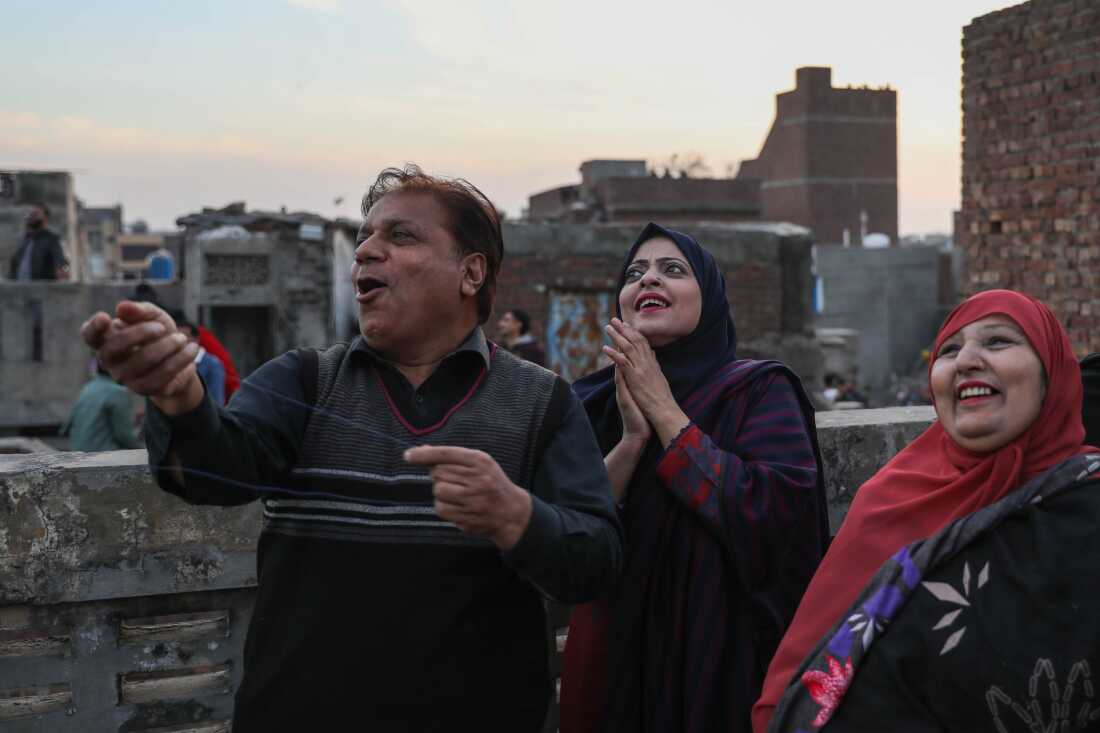
Zaib Un Nisa (center) watches her husband Aqeel Ahmad fly a kite on a rooftop. Betsy Joles for NPR hide caption
toggle caption
Betsy Joles for NPR
Although there were no deaths this year related to kite string, six people died falling from rooftops and by electrocution after trying to retrieve kites from telephone poles, authorities said. A lawyer filed a petition in the Lahore High Court related to the deaths, arguing that the festival remains dangerous.
Now that Basant is officially over, according to Punjabi law, kite flying is back to being prohibited. It's unclear whether Basant will return to Lahore or other parts of Punjab next year — though this spring, at least one other Punjabi city continues to lobby for its chance to celebrate.
Zaib Un Nisa says people need a reason to celebrate — and irrepressible Lahoris will take every opportunity they can. She says a Lahori is someone with a lively heart. Just then, her husband interrupts her with a celebratory chant — shouting nicknames of others on the rooftop, followed by "zindabad" (long live!) — which gets everyone laughing.
She looks at him and chuckles: "This is a Lahori."
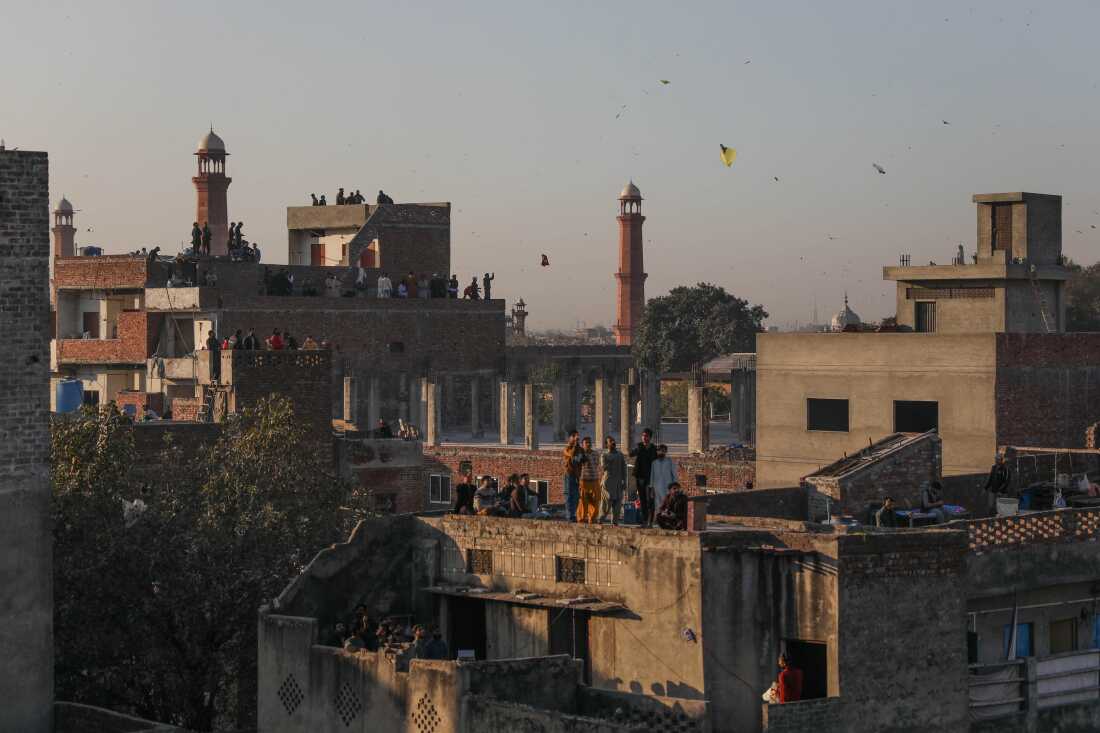
Kites dot the sky as people stand on rooftops in Lahore's Old City. Betsy Joles for NPR hide caption
toggle caption
Betsy Joles for NPR